Welcome back! Let's unpack what an online store really costs — every line, honestly explained. 🧱
| Quick answer: store pricing is a ladder — platform fee, payment fees, apps and theme; count all four rungs before you compare providers. |
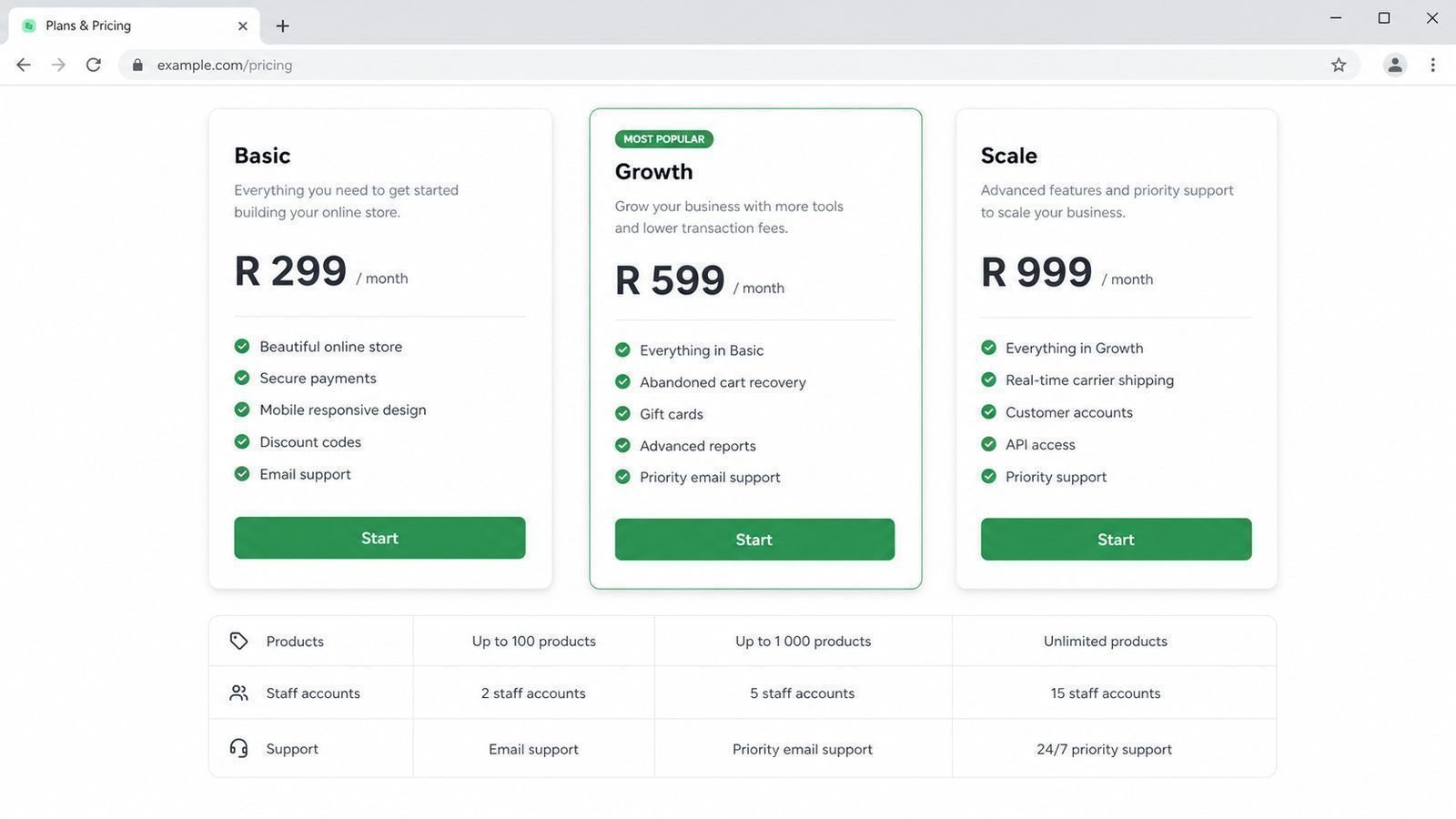
Every store quote you will ever receive is one of three tiers 🏷️. Once you can name the tier, you can compare quotes properly — because comparing a tier-one store to a tier-three store is like comparing a bakkie to a truck.
The Three Tiers
| Tier | Build cost | Monthly | Best for |
|---|---|---|---|
| Platform store | R2,000 – R10,000 | R150 – R1,500 | Most first stores, under ~200 products |
| Platform, professionally built | R10,000 – R35,000 | Same, plus support | Brands with content and options |
| Fully custom store | R35,000 – R150,000+ | Hosting and upkeep | Complex pricing, integrations, scale |
What I Sit Outside Every Store Quote 🧮
- Payment gateway: about 2% – 3.5% plus small per-transaction fees
- Courier integration: free accounts, per-parcel charges
- Product photography: R0 by phone in good light, or R2,500+ per shoot
- Marketing: at least R1,500 – R3,000 a month to bring the first traffic
- Content: descriptions and titles done properly, by you or someone paid
Choosing Your Tier 🔌
If you sell fewer than two hundred products with normal pricing, a professionally built platform store is almost always the right answer: fast to launch, easy to change, and hands you ownership of the catalogue. Custom builds earn their price when the rules get unusual — trade pricing, complex shipping, subscriptions, or connections to systems you already run.
The Questions That Reveal the Tier
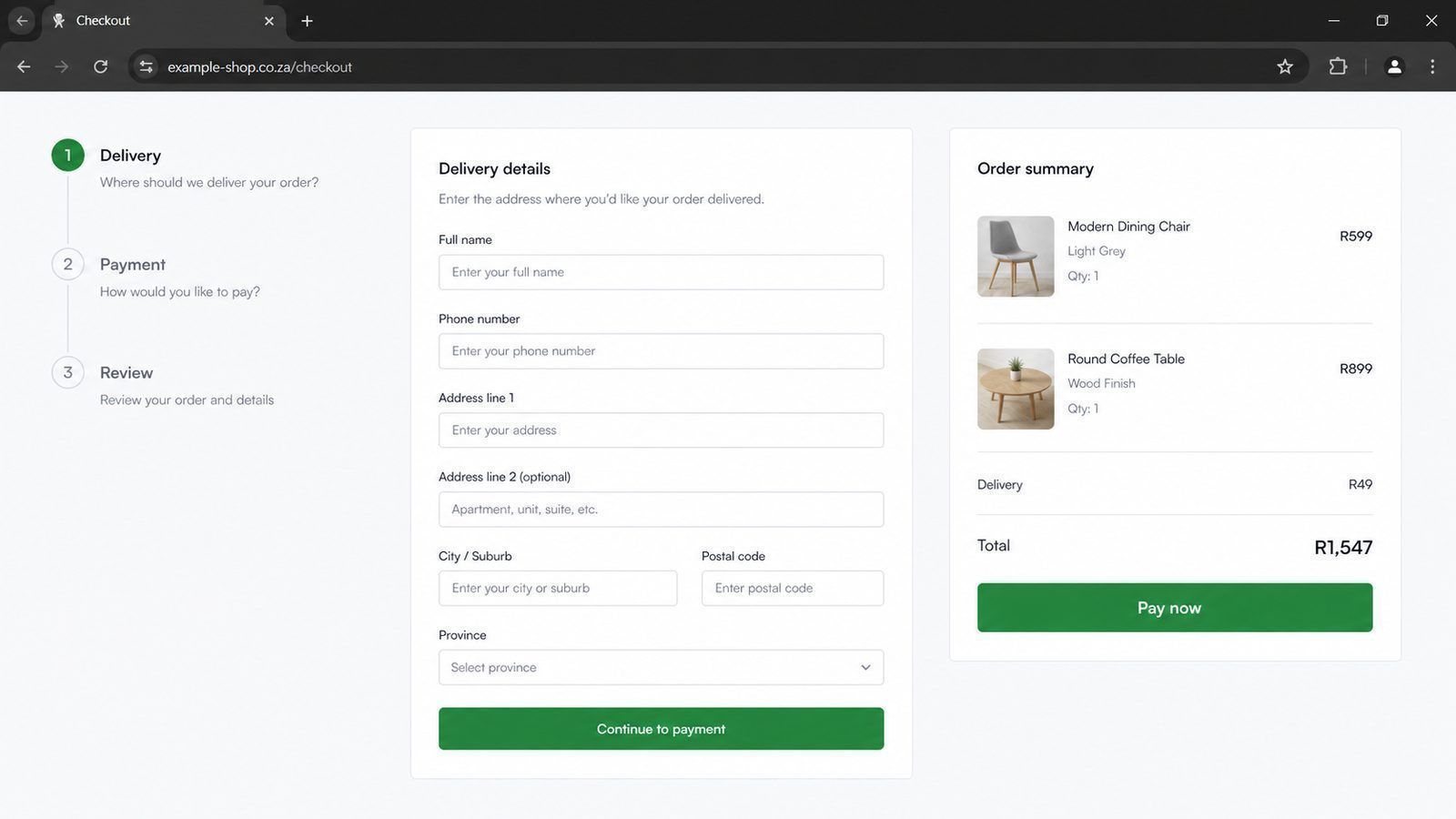
Three questions separate the store tiers quickly. How are prices and products managed — by hand, by spreadsheet import, or by a direct feed from your stock system? How many product options per item are supported without customising anything? And what happens at order fifty a day — does the checkout still work on mobile data in a taxi?
Cheap tiers answer the first two adequately and the third poorly; custom builds exist mainly to answer the third well. If your business lives in the first two questions, you do not need the third tier yet — and paying for it early is one of the most common overspends we see.
Where Stores Actually Lose Money
Four leaks account for most lost revenue:
- Cart abandonment at the delivery step — usually caused by unclear or expensive shipping
- Product pages missing sizes, materials and returns information
- Slow mobile performance caused by oversized images
- No answer to the question “is this in stock?”
- Marketing spend on traffic arriving to a store with no reviews or proof of delivery
What Each Tier Can Realistically Do
Knowing which tier a store sits in answers most pricing questions before you ask them.
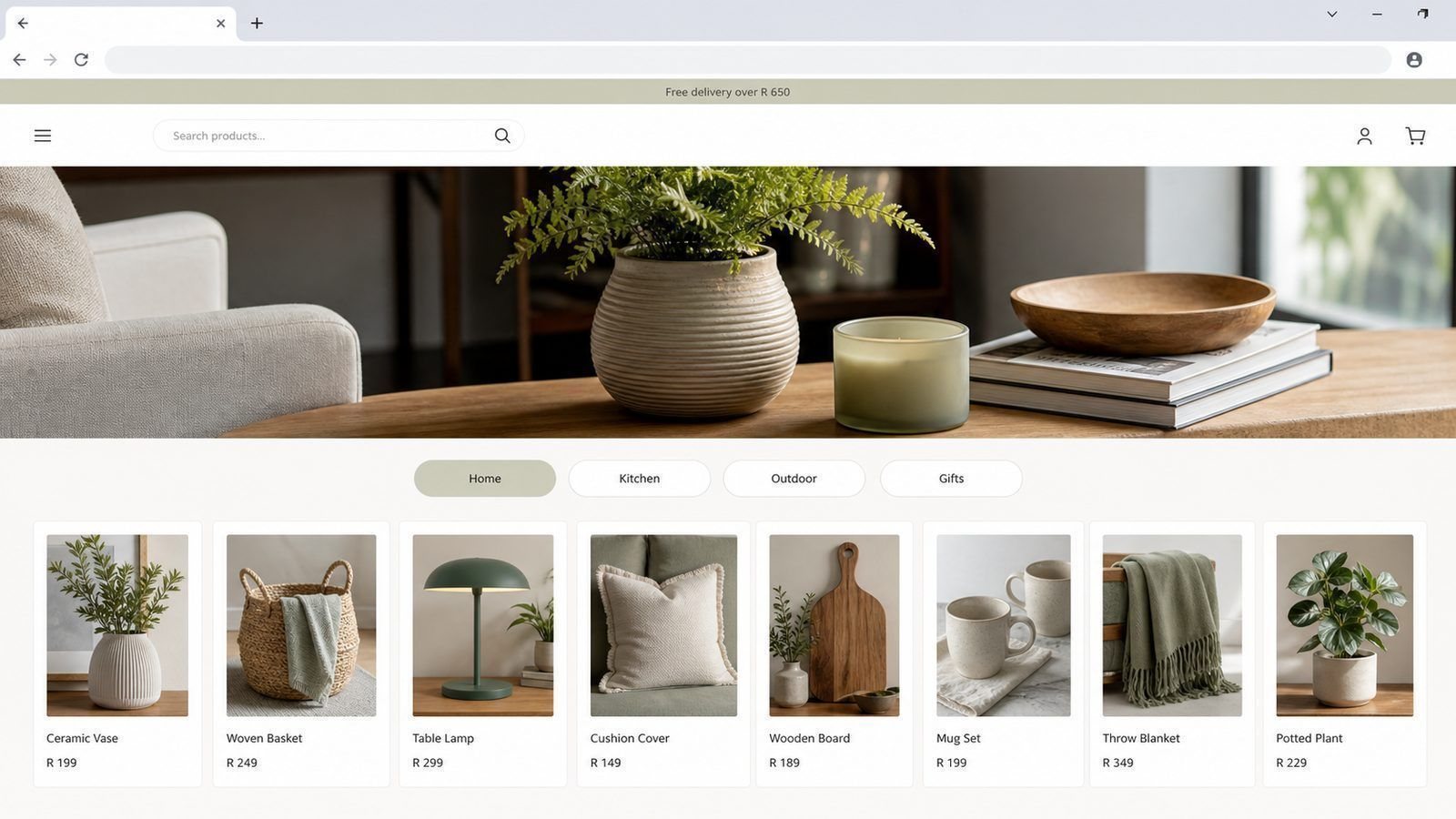
- Entry store: catalogue, cart, one payment gateway, a handful of products
- Mid-tier store: stock levels, discount codes, courier integration, reviews, basic reports
- Custom store: unusual pricing, subscriptions, account pricing, integration with your own systems
Move up a tier when a real requirement forces it — not when a demo screen looks impressive. Enquiries, not features, are the signal: if you cannot keep up with the orders your current store produces, that is a delivery problem, not a software one, and a new tier will not fix it.
Normalising Plans You Cannot Compare
Quotes for stores rarely describe the same thing. Force them onto one sheet before deciding.
| Ask every provider | Why |
|---|---|
| Products it can hold comfortably | Volume changes the tier you need |
| Payment gateways supported | Unsupported methods cost sales |
| Stock handling | Manual, spreadsheet or feed changes daily admin |
| Courier integration | Cheaper shipping and fewer errors |
| What happens at 50 orders a day | Where cheap plans quietly fail |
| Who supports you during peak | Sale weekends are not the time to meet your provider |
Fill one sheet per quote beside each other. When the columns line up, price comparison becomes honest instead of decorative.
Test the Tier Before You Commit
You do not have to guess which price tier you need. Load ten products onto the middle option, take a hundred visitors through checkout, and watch two things: how many complete an order, and how long the admin takes you each evening. If the admin is painless and the checkout completes, the entry or mid tier is sufficient.
Move up only when a specific requirement blocks you — stock syncing with your physical shop, a pricing rule the platform cannot express, or order volume that the reports cannot handle. “More features” is not a requirement; a blocked process is.
Two weeks of testing costs almost nothing and usually saves a year of paying for a tier whose extra screens nobody opens.
Frequently Asked Questions
Why do some stores cost R5,000 and others R80,000?
Product count, custom design, integrations and the rules around delivery and returns. Ask for the included list and the gap explains itself.
Can I move to a custom build later?
Yes, if your product data is clean and exportable. That is one more reason to start on a mainstream platform rather than an obscure one.
What is the biggest cost people forget ⚖️?
Content and marketing. A beautiful store with no products written and no traffic is a photo of a shop.
When should I move up a tier?
When a real requirement blocks you — stock that cannot sync, pricing rules the platform cannot express, or order volumes the reports cannot handle. Not when a demo screen looks impressive. Requirements force upgrades; features merely tempt them.
Should I show prices in rands only?
Yes for a South African audience. Multi-currency pricing looks sophisticated and usually confuses the majority of your buyers, who want one clear number and a delivery cost they can predict.
Do I need a blog on my store?
Only if you will maintain it. A store with a good delivery and returns page converts better than one with three abandoned blog posts, and it costs nothing to get right.
Open the shop while the demand is there. See online store packages — from R5,500Get my free store quotation |