Welcome! Let's map the funding routes open to you, and what each one wants first.
| Quick answer: match the route to the stage — grants, agency support, bank finance and investors each want different paperwork and different proof. |
Funding in South Africa is rarely a shortage of schemes and almost always a paperwork problem 🏦. There are grants, loans, equity deals and blended products — and between you and each of them sits a document pack that is either ready or not.
The Four Routes
| Route | What it is | What it expects |
|---|---|---|
| Government grants and programmes | Support for youth, women and specific sectors | Registration, compliance, a plan, often training |
| Bank and commercial loans | Repayable finance | Track record, statements, security or guarantees |
| Equity investors | Money for a share of the business | Growth potential and a partner’s voice |
| Revenue-based / alternative finance | Repaid as a share of turnover | Proven monthly income and clean books |
The Universal Pack 🧾
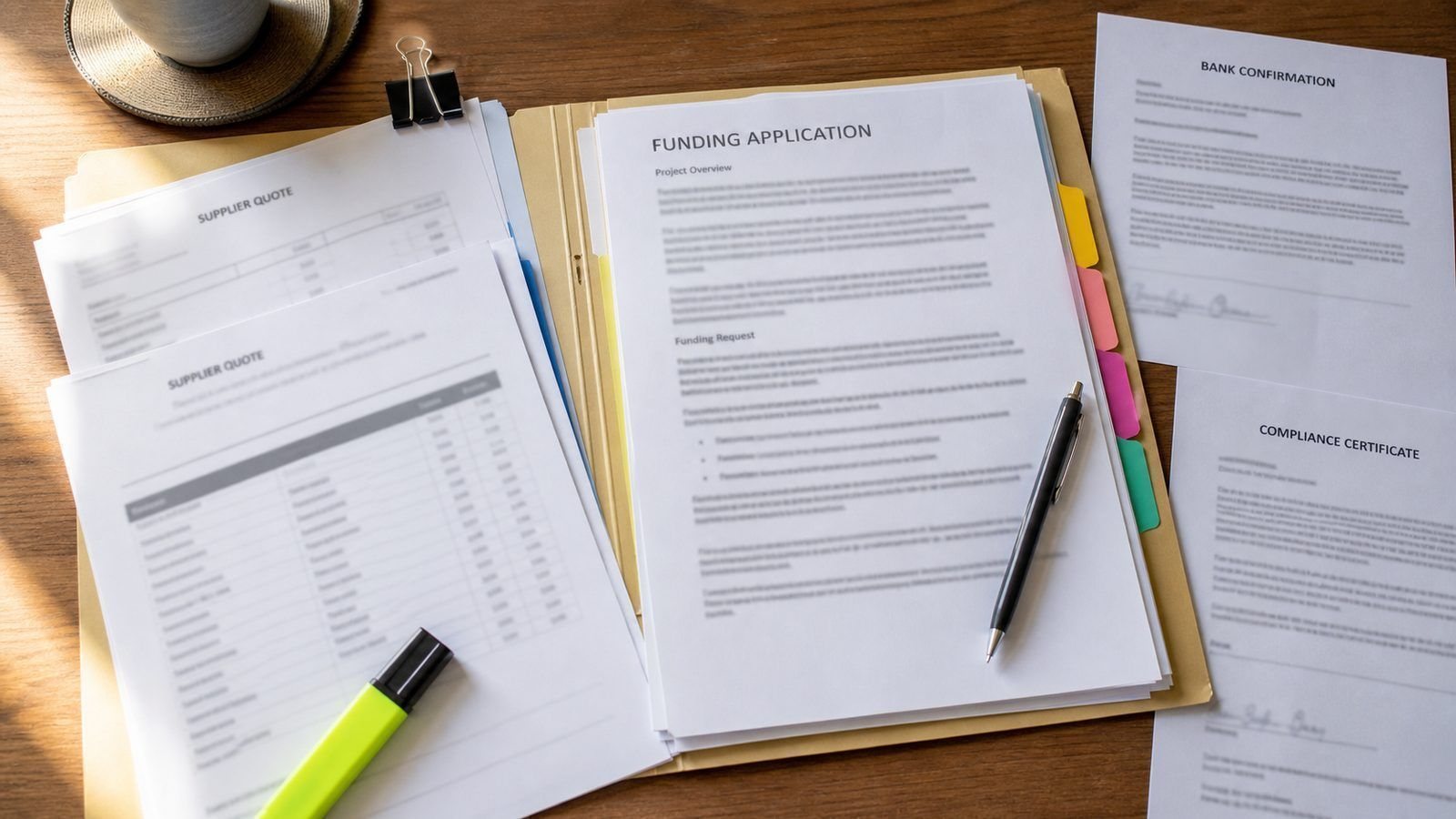
- CIPC registration and a current tax compliance status
- Six months of bank statements
- A business plan with monthly financials
- Quotes for whatever the money will buy
- Directors’ IDs and proof of address
- Industry-specific licences, where they apply
Keep this folder current, on a cloud drive, in date order. It takes a day to assemble properly and it is the difference between applying this month and applying in three.

Choosing the Right Route 💡
Grants suit owners who can wait for a process and complete training if required. Loans suit businesses with revenue they can forecast. Equity suits businesses that will grow fast and can live with a partner. Revenue-based finance suits steady, cash-generating businesses that dislike fixed repayments. Picking the wrong route does not just waste time — it can cost you control or cash flow you did not have to give away.

The Mistakes That Cost Months ⚠️
Expired compliance documents. Bank statements that do not match the plan. A funding request with no itemised use. Applying to five funders with the same generic motivation. And, most commonly, asking for money before the numbers exist to justify it.

Getting Funded Without a Grant
Most small businesses are funded by customers long before anyone else. Three practical routes: ask for a deposit on large jobs so the work funds itself; negotiate supplier terms so stock is paid after it sells; and stagger big purchases so equipment arrives after the revenue that justifies it. None of these require an application or a committee, and together they fund a great deal of growth.
When you do approach a lender or programme, this history helps: your own records show ability, and ability is what underwriters underwrite. The business that can show six disciplined months of deposits and payments is a far easier application than one asking for the money to start.
Building the Relationship Before You Need It
Funders fund known quantities. Attend the workshops, introduce yourself at the local office, ask what a good application looks like, and come back when you fit the criteria rather than when you are desperate. One visit early saves months later.
Keep the same pack you would submit, updated quarterly. When an opportunity opens with a two-week window, being the applicant who already has the folder ready is the entire advantage — and it is an advantage you can prepare for starting this week.
The Ten-Document Folder to Keep Ready
One folder, digital and current: company registration, tax compliance status, six months of bank statements, management accounts or a bookkeeping summary, the business plan with financials, supplier quotes for the intended spend, directors’ IDs and proof of address, licences for your industry, a signed lease or premises proof, and a one-page summary of the business.
Update it every quarter — statements get stale in weeks, and compliance documents expire quietly. The goal is that an opportunity with a fourteen-day window finds you already 90% ready, which is the exact position most declined applicants would pay to be in.
Five Ways Applications Fail
| Failure | Prevention |
|---|---|
| Expired documents | DIY compliance calendar, checked quarterly |
| Numbers that contradict statements | Build projections from the actual bank data |
| No itemised use of funds | Attach supplier quotes, line by line |
| Generic motivation letter | Write to the specific programme’s criteria |
| Applying too late | Start the pack before the cash crunch |
Every one of these is avoidable with a folder and a calendar. The businesses that prepare quietly are the ones that get funded when the window opens — and often on the first attempt.
| Match the route to the stage Grants: compliance-heavy, patient. Agency support: mentorship plus small cash. Bank finance: security and statements. Investors: equity and exits. Pick one lead route first; scatter-gun applications read as desperation. |
Frequently Asked Questions
Do grants have to be repaid?
Grants generally do not, but they come with conditions — reporting, training, or spending rules. Read the terms before celebrating.
Can a new business get a loan?
Rarely from a bank. Usually through programmes, suppliers extending terms, or revenue-based finance once sales exist.
What is the fastest route?
Supplier credit and revenue-based finance move fastest, because the decision is built on your own records rather than a committee 📋.
How often should the pack be refreshed?
Quarterly. Bank statements age fastest, compliance documents expire quietly, and quotes are usually valid for a limited period. Diary one afternoon every three months and the next opportunity never finds you unprepared.
Should the business be registered before applying?
Most funders prefer it, and some require it. Registration also unlocks a business bank account, which produces the statements every application asks for. Do that step first — it takes days, not months.
Is it better to ask for less?
Ask for what the plan can justify and service. An overstated request with thin arithmetic damages credibility more than asking for a smaller, well-defended amount.
What if I am declined?
Ask what would make the application stronger, fix that specifically, and reapply when the gap is closed. A decline with feedback is a roadmap; a decline without asking is just a setback.
Get your funding pack ready before the deadline does. See funding-ready packs and profilesAsk for a funding readiness check |